Art, Wine, and Wealth Along America’s Most Historic Waterway
By David Baum with photos by Susie Baum
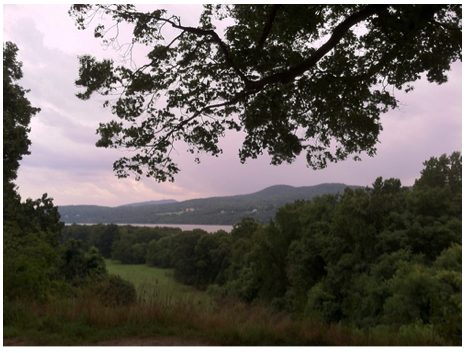
I’m standing on a grassy knoll beneath a Persian palace, and for a moment I feel like I’ve been transported to another world. The views from this historic site – the former home of landscape artist Frederick Edwin Church – look more like a stretch of the Rhine River in Western Germany than Upstate New York. Stretching to the horizon in both directions, the Hudson River has an ethereal glow reminiscent of one of Church’s paintings. To the west the contours of the Catskill Mountains are discernible through the August haze. Behind me lies the architectural masterpiece that Church built in 1870, having carefully selected the site for its exceptional vistas, many of which he later painted.
“Church’s artwork is characterized by a calmness and sense of hope,” the tour guide tells us. That’s precisely how I feel at this moment, two days into a four-day road trip in the Hudson Valley.
During previous visits to New York my wife and I had never left Manhattan. This time, having just tucked our daughter into a dormitory for her freshman year at NYU, we decided we were ready to try something new: an indulgent country ramble, with stops at bed & breakfasts in the towns of Hudson and Cold Spring. The Olana tour is quickly becoming one of the highlights. Church traveled extensively throughout South America, Europe, and the Middle East, where he became entranced with Moorish architecture, we learn as we enter the ornate three-story house, which looks more like a Greenwich Village opium den than the home of a genteel Victorian family, replete with exotic tapestries and other furnishings collected from their travels. Dozens of paintings by Church and other artists line the walls.
The Hudson Valley is famous not only for the artistic heritage of the Hudson River School, but also for its authors (Washington Irving), politicians (Franklin D. Roosevelt), and captains of industry (John D. Rockefeller, William Vanderbilt, Ogden Mills), whose palatial homes epitomize the fabulous wealth and unbridled aspirations of the Industrial Age.
Visiting these majestic country manors was partly our motivation as we motored up Highway 9 on day one of our journey. Our first stop was the Vanderbilt mansion in Hyde Park, a 54-room Greco Roman structure perched amid 670 acres of riverfront property. Wandering through the estate’s wooded grounds, it was hard to imagine that this was the smallest of Vanderbilt’s four country mansions. We continued north to Rhinebeck, a delightful town that boasts the oldest inn in America, the Beckman Arms. George Washington is said to have dined here, and the dark-wooded tavern looks much the same today as it did when he visited more than 200 years ago.
There is no shortage of cultural landmarks in this region, but after two days of museums we were ready to enjoy one of the Valley’s other great pleasures: wine. As the oldest winemaking region in the U.S., the Hudson River Valley has about three-dozen wineries, many of which offer tours and tastings.
Hudson River wines are different from the ones my wife and I commonly drink from California. French-American grape varieties such as Seyval Blanc and Baco Noir take naturally to this temperate climate, along with delicate European grapes such as Chardonnay and Cabernet Franc. In good years these varietals thrive, but unpredictable summer weather affects the quality from year to year.
“We would just as soon forget 2011,” explained the wine steward at Benmarl Winery, recalling the torrential rain from Hurricane Irene during that summer’s crucial ripening period.
Our favorite wine during our three-day sojourn was a 2010 Cabernet Franc from Millbrook Vineyards, which we enjoyed over dinner at the Riverview Restaurant in Cold Spring. Often used as a blending grape, Cabernet Frank is lighter than Cabernet Sauvignon, its robust Bordeaux cousin, but with a similar finesse and peppery perfume. We also liked Millbrook’s 2009 Proprietor’s Special Reserve Chardonnay and a 2010 Reserve Chardonnay from Benmarl. These taut white whines are characterized by a higher acidity and leaner style than the California chardonnays we are used to, but they are wonderful food wines with plenty of subtlety.
The standout on Benmarl’s tasting list was a 2009 Zinfandel with “notes of fig, plum and cocoa,” according to the tasting notes. As I attempted to detect these elusive aromas, I realized that the long, warm finish of this big red wine was wholly out of character with the others we had been sampling. The pourer explained the wine’s pedigree: the fruit was grown in the Sierra Foothills of California and subjected to a three-day continental journey before being crushed locally. This extra ripening period raised the sugar levels, giving the wine a 16 percent alcohol level once fermented dry.
I begged for another pour and took my glass outside to savor the splendid view.
The next day we decided to head inland towards the Catskill Mountains. We stopped to browse through shops and galleries in the fabled town of Woodstock (the 1969 music festival actually took place about 40 miles from here), and then made our way south to the Mohonk Preserve, a nature lover’s paradise with unique rock formations and miles of hiking trails. Along the way we passed grand Victorian homes, stately old barns and, finally, rolling vineyards, as the mountains of Mohonk gave way to the farms and wineries of Ulster County.
Crossing back over the river near Newburgh, we stopped in the town of Beacon, a riverfront community that has recently enjoyed a renaissance for its lively arts and antiques scene. Along with Hudson and Cold Spring, Beacon is one of the best spots for antique shopping. Unfortunately, we did more window-shopping than actual shopping due to the timing of our visit, since many stores are closed during the early days of the week.
On our final day we headed south along the east side of the river. A stop to tour Philipsburg Manor took us back more than three centuries. This remarkably preserved farming, milling, and trading center was established by a wealthy Anglo-Dutch merchant in 1693. During its hay day his family owned 52,000 acres here, along with nearly two-dozen enslaved Africans, who were indentured to operate the complex.
“Twenty-three slaves lived in this small area,” a tour guide told us as we walked through the cramped first-floor quarters of the 300-year-old manor house. I tried to imagine the living conditions in this squat, airless room, making a mental note to remind my daughter of the comparative luxury of her triple dorm room back on campus.
One of the most memorable stops of our entire journey was St. Philip’s Church, which we stumbled upon by accident as passed through Garrison. Designed by Richard Upjohn, a 19th Century architect who is famous for Gothic Revival churches—including Trinity Church in Lower Manhattan—this lovely stone building commands a grassy knoll surrounded by hundreds of ancient tombstones. George Washington and Benedict Arnold have a place in this church’s history, I later learned, and Upjohn himself is buried in the churchyard.
I didn’t see that particular grave as I wandered pensively among the faded burial markers, but many others caught my eye, such as a the final resting place of Abraham Kerns Arnold, born March 27, 1837, the same birthday as my daughter. According to his tombstone, Arnold won a Congressional Medal of Honor for his valiant command of the 22nd U.S. Cavalry during the Civil War. I was also struck by a triptych of matching gravestones, faded to almost white and leaning with the hill. I couldn’t make out the writing on the front side of the stones, but the back sides were each adorned with a single word: Mother, Father, Sister.
Picturesque graveyards such as this one are not uncommon in the northeast. But as a west-coast native, these hallowed plots always captivate me with their faded graves and tantalizing bits of history. Lost in my thoughts during our final drive to Newark Airport, I felt dwarfed by the immense weight of time, the unwavering sweep of years connecting all souls—rich and poor, free and enslaved, cursed and blessed. What might lie ahead for our daughter as she attempts to make a home here, so far from everything our family has known? What lives will she touch, what stories will unfold as she finds her place in this new world?
Alas, such thoughts quickly subsided with the busy airport hustle—returning the car, finding our gate, and settling in for the long flight home. As the jet rose out of Newark, I couldn’t help craning my neck for a final view of the majestic river that has played such an important role in our nation’s history—and, undoubtedly, will soon establish itself in our family history as well.
– David Baum is a freelance writer based in Santa Barbara who frequently writes about travel, wine and lifestyle issues.


You must be logged in to post a comment.